5 Certifications That Explain the True Price of Ethical Fashion: GOTS, OEKO-TEX, GRS, OCS, Fair Wear Decoded
A Seemingly Ordinary Object
You hold a t-shirt in your hands. A few grams of fabric, two side seams, a crew neck. Nothing seems more ordinary. And yet, what you are holding is the culmination of years of audits, laboratory tests, factory inspections, water sampling, field visits, and signatures across dozens of offices.
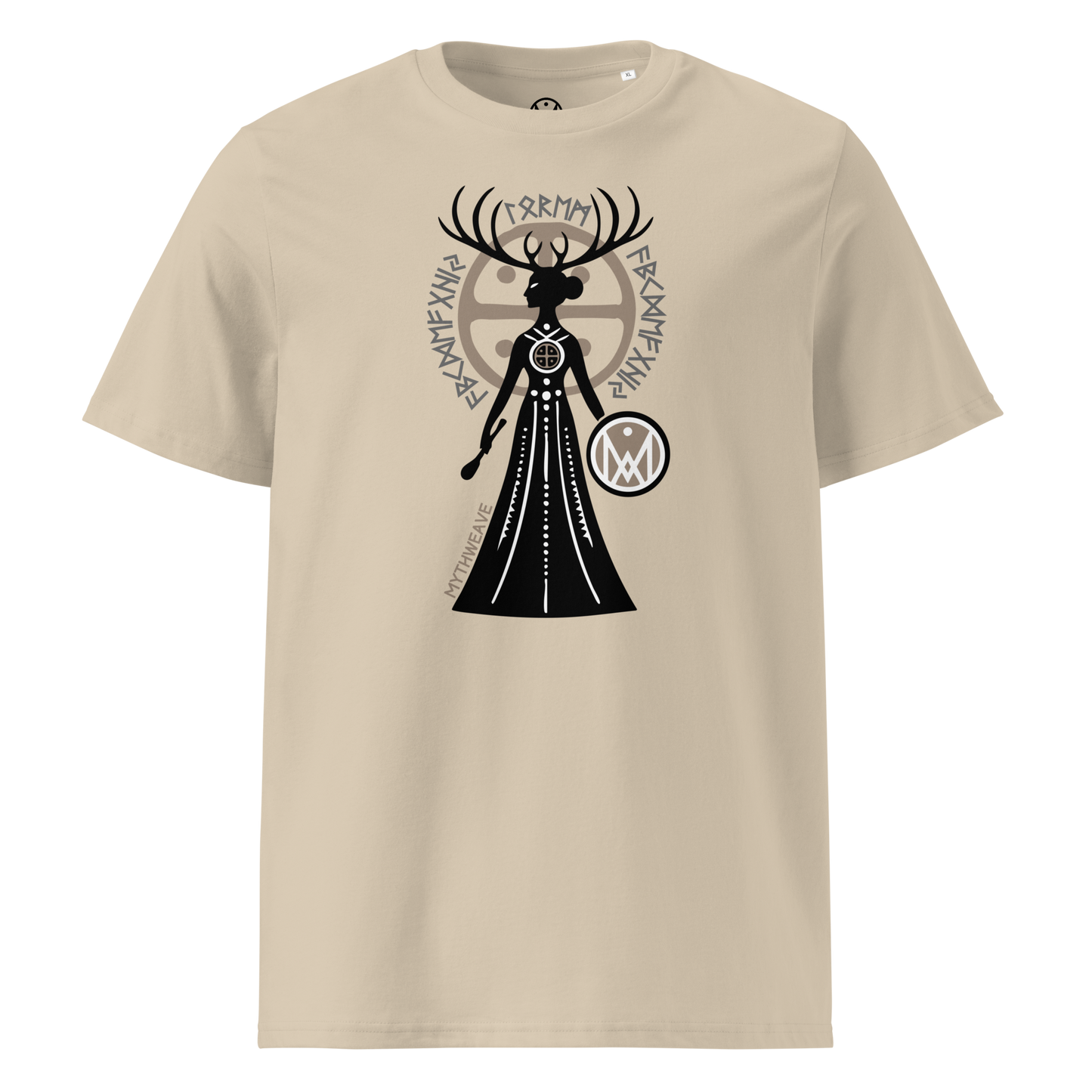
This garment is our MYTHWEAVE t-shirt. Crafted by the Stanley/Stella workshops, it bears five of the strictest labels in the textile world: GOTS, OCS, GRS, OEKO-TEX Standard 100, and PETA-Approved Vegan, all backed by the commitment of the Fair Wear Foundation.
These names might ring a bell, or they might mean nothing at all to you. That is completely normal. The global textile industry is an opaque maze where the vast majority of brands reveal absolutely nothing about what happens between the cotton field and your wardrobe. This silence is no accident. It is convenient, it is profitable, and it allows t-shirts to be sold for 15 euros without anyone asking the right questions.
This article offers the opposite. We are going to look under the hood. To dissect, step by step, what really happens behind each of these acronyms, why they exist, what they prohibit, what they enforce, and why the price of a t-shirt bearing all of them cannot, by design, resemble that of a supermarket t-shirt.
Get ready: this journey begins in a field.
The Hidden Side of an Ordinary T-Shirt
Before understanding what certifications protect, we must face what they are trying to replace. And it isn't pretty.

Conventional cotton, the material making up the vast majority of t-shirts sold worldwide, is one of the most chemically intensive crops on the planet. Cotton farming alone consumes around 12% of all insecticides sold globally, despite representing only 2.5% of cultivated land. In other words, a disproportionate amount of toxic molecules is dumped onto fields that, ultimately, end up against your skin.
These products don't just disappear. They seep into groundwater, contaminate rivers, poison the farmers who often handle them without protection, and permanently deplete the soil. In some producing regions, rates of cancer, birth defects, and neurological disorders are skyrocketing around cotton zones. That plain white t-shirt you buy for 15 euros has very likely contributed, without your knowledge, to poisoning a farming community.
Once harvested, this cotton enters the factory. And here again, the picture darkens. To transform a fiber into an immaculate white fabric, the conventional industry uses a cocktail of chlorine bleaching, heavy-metal-based dyes, formaldehyde fixatives, brominated flame retardants, and optical brighteners. Many of these substances are recognized as carcinogens, endocrine disruptors, or severe allergens. They are never entirely washed out: a portion remains trapped in the fibers and slowly migrates to your skin through sweat and friction.
Un t-shirt à 15 euros ne peut tout simplement pas être éthique. Les mathématiques l'interdisent. On the human side, the situation is just as damning. As we recalled in The Heart of Our Project, only 2% of textile workers worldwide earn a living wage, and the share of labor costs in the price of a conventional t-shirt sometimes falls below the 1% mark. A 15-euro t-shirt simply cannot be ethical. The math makes it impossible.
It is against this, against all of this, that the standards we are about to explore were built, one after the other. Each addresses a different angle of the problem. Together, they form a dense safety net that is demanding and costly to maintain, but which changes everything.
GOTS : The Global Passport for Truly Organic Cotton

Let's start with the cornerstone of our approach: GOTS (Global Organic Textile Standard).
GOTS is not a self-awarded logo. Today, it is the most demanding standard in the world for organic textiles, and obtaining it is more akin to an ongoing examination than a simple administrative validation.
What GOTS Actually Requires
For a product to bear the "GOTS Organic" label, it must contain a minimum of 95% certified organic fibers. For the "GOTS Made with Organic" label, this drops to a minimum of 70%. Our t-shirt falls into the first category: its certified composition is 100% organic cotton (material reference RM0104 in the scope certificate). Not 99. Not "mostly." One hundred.
But GOTS doesn't just look at what grows in the field. It tracks the fiber from the seed to your mailbox. At every stage: ginning, spinning, weaving, dyeing, manufacturing, packaging, shipping, a certified operator must prove that the organic batches have never been mixed or contaminated by conventional cotton. This is known as the chain of custody, and it is documented by transaction certificates (TC) that accompany every delivery.

The Chemical Blacklist
Where GOTS becomes downright uncompromising is what happens in the dye baths. Strictly prohibited are:
· Toxic heavy metals (chromium VI, lead, cadmium, mercury)
· Formaldehyde
· Aromatic solvents
· Functional nano-particles
· Genetically modified organisms (GMOs) and their enzymes
· Brominated flame retardants
· Perfluorinated agents (PFAS, aka "forever chemicals")
Chlorine bleaching is banned: only oxygen-based solutions are allowed because they do not generate carcinogenic organochlorine byproducts. Any dye, auxiliary, or chemical product entering a certified factory must have been previously evaluated for its acute toxicity, biodegradability, and eliminability.
The Water Aspect, and the Forgotten Human Aspect
A GOTS factory must treat its wastewater before discharge. Not suggested: required. And beyond the environment, the standard enforces social criteria aligned with the fundamental conventions of the ILO (International Labour Organization) and the Universal Declaration of Human Rights: prohibition of forced labor, prohibition of child labor, freedom of association, non-discrimination, occupational safety, a living wage, and reasonable working hours. A workshop failing to meet these criteria loses its certification, period.
OCS : Traceability as a Safeguard

Whereas GOTS dictates both composition and manufacturing methods, OCS (Organic Content Standard) focuses on one single thing: tracking the organic content to prove that the organic material is genuinely organic. At each step, the standard verifies how much organic fiber was purchased, processed, and sold, cross-referencing these flows to ensure no brand claims to use organic cotton on a product without actually doing so.
It is a formidable anti-fraud mechanism. Without OCS or an equivalent, any brand can claim to use organic cotton without any documents to actually prove it. With OCS, every kilogram of certified fiber is counted, dated, tracked, and can only be used once.
OEKO-TEX Standard 100 : 1,000 Substances Screened

If GOTS and OCS handle the raw material and its traceability, OEKO-TEX Standard 100 deals with a terribly more intimate question: what remains in the fabric once the t-shirt is finished, and what will come into contact with your skin?
The Principle: Testing What the Consumer Will Wear
OEKO-TEX doesn't test fibers, dye baths, or factories. It tests the finished product. The t-shirt exactly as it will come out of the box. And it tests it against a list of over 1,000 substances potentially harmful to human health, updated annually by an independent scientific consortium.
Specifically, they test for:
· les amines aromatiques cancérogènes issues de certaines teintures azoïques
-
Carcinogenic aromatic amines from certain azo dyes
-
Extractable heavy metals (lead, cadmium, nickel, arsenic, antimony, mercury...)
-
Formaldehyde, classified as a known carcinogen since 2004
-
Residual pesticides and herbicides
-
Plasticizing phthalates
-
Organotin compounds (TBT, DBT)
-
PFAS (per- and polyfluoroalkyl substances)
-
Allergenic or carcinogenic dyes
-
Chlorophenols (PCP, TeCP)
-
Polycyclic aromatic hydrocarbons (PAHs)
And this is just a sample. Every component must be tested separately: the main fabric, the sewing thread, the label, the screen-printing ink, and any plastic snaps. If even a single piece exceeds the thresholds, often set well below legal limits, the certificate is not granted.
Four Classes, From Strictest to Least Strict
OEKO-TEX has defined four product classes, calibrated according to the intensity of skin contact:
-
Class I — Products for babies and children up to 3 years old (the most sensitive, the most drastic thresholds)
-
Class II — Textiles in direct contact with the skin (underwear, t-shirts, shirts) → this is our category
-
Class III — Textiles without direct contact (jackets, coats)
-
Class IV — Furnishing and decorative textiles
The fact that our t-shirt is certified Class II means it has passed the strictest tests available for adult clothing. The exact same requirement applied to panties, bras, or pajamas, meaning anything that rubs, makes you sweat, and sticks to your skin for hours.
And as if that weren't enough, OEKO-TEX conducts unannounced checks on at least 25% of the certificates issued each year. A manufacturer cannot rest on their laurels: at any moment, a sample can be taken from a store, retested, and its certificate suspended in the event of non-compliance.
It is this exact mechanism (silent, scientific, exceedingly boring) that makes an OEKO-TEX Class II t-shirt arguably the most rigorously tested textile object you could possibly wear against your skin.
PETA-Approved Vegan : A T-Shirt That Cost No Animal Its Life

It is often forgotten, but an "ordinary" cotton t-shirt can contain animal-derived components. The glue used to attach certain labels can be bone-based. Some softening finishes use tallow. Mother-of-pearl buttons come from shells, and some threads are blended with undeclared silk or wool. Animals are sometimes hidden where you least expect them.
The PETA-Approved Vegan label exists precisely to make this presence impossible.
In practical terms, this label guarantees that no animal-derived component was used in making the garment, accessory, hat, or outerwear in question. No wool, no silk, no leather, no down, no fur, no derived ingredients (casein, keratin, lanolin...), no animal glue, no beeswax in the finishes. Nothing.
For MYTHWEAVE, this choice aligns with our global vision: we cannot claim to weave a future that respects living things while ignoring the animal kingdom. Whether you are vegan or not, this label simply guarantees that your purchase did not involve the exploitation or killing of a sentient being at any link in the chain.
It is one more requirement. One of those that, stacked together, end up mattering.
Fair Wear Foundation : What About the Humans?

We have talked about cotton. We have talked about chemicals. We have talked about animals. Now remains the most important question of all, the one ultra-fast fashion prefers we never bring up: the hands that sewed your t-shirt, what does their life look like?
The Stanley/Stella workshop is a member of the Fair Wear Foundation (FWF), a Dutch NGO founded in 1999 and considered today as one of the global benchmarks for social ethics in garment manufacturing. The FWF works with its member brands in 11 producing countries among the most exposed to abuses: Bangladesh, Bulgaria, China, India, Indonesia, Myanmar, North Macedonia, Romania, Tunisia, Turkey, and Vietnam.
Joining Fair Wear isn't about getting a stamp of approval; it is committing to an ongoing process. FWF actually doesn't issue a certificate, and this is intentional: their philosophy assumes that 100% perfect ethics is never fully achieved, and that transparency regarding progress is worth more than a label.
The Eight Pillars of Dignity at Work
Fair Wear's Code of Labour Practices is based on eight principles, all drawn from ILO conventions and the Universal Declaration of Human Rights:
-
Employment is freely chosen. No forced labor, no debt bondage, no prison labor.
-
No discrimination. Recruitment, wage policy, admittance to training programs, promotion policy, policies of employment termination: everything must be independent of race, gender, religion, union affiliation, nationality, or disability.
-
No exploitation of child labor. No exceptions.
-
Freedom of association and the right to collective bargaining. Workers have the right to form or join trade unions and bargain collectively.
-
Payment of a living wage. Not just the local minimum wage—which is often insufficient to live on, but a wage that actually covers food, housing, healthcare, children's education, and allows for some savings.
-
Reasonable hours of work. Maximum 48 hours per week regularly, at least one day off per seven-day period, overtime is voluntary only and capped at 12 hours per week, always paid at a premium rate.
-
Safe and healthy working conditions. Protection against industrial risks, proper training, equipment, accident prevention.
-
Legally binding employment relationship. Written contracts, real social protection, prohibition of abusing subcontracting or fake apprenticeships to bypass these obligations.
How is this verified?
Each member brand undergoes an annual Brand Performance Check (BPC). A team of independent auditors visits the supplier factories, conducts direct interviews with workers (without management present), inspects payroll documents, checks time records, controls emergency exits, and examines protective equipment. The results are public and provide a concrete measure of each brand's progress or shortcomings.
Why Does an Ethical Fashion T-Shirt Cost More? The Hidden Bill of a 15-Euro T-Shirt

Now that we have covered all these certifications, we can finally ask the question everyone silently wonders: so why does a MYTHWEAVE t-shirt cost nearly 70 euros, when you can find one for 15 in any supermarket?
The answer boils down to one sentence: a 15-euro t-shirt is not really sold for 15 euros. It has simply deferred its true cost onto someone else.
The True Cost of a Conventional T-Shirt
When you buy a 15-euro t-shirt, you pay 15 euros. But the cotton inside it cost the planet hundreds of liters of irrigation water drawn from depleting aquifers, kilos of pesticides dumped into sometimes unrecoverable ecosystems, and CO₂ emissions that contribute to climate change. That debt, you don't pay. Your grandchildren will.
The garment worker who sewed it probably earned the equivalent of a few cents for the operation. In Bangladesh, the minimum wage in the textile sector in 2024 is around 100 to 120 euros per month, for 60 hours of work per week. That debt, she pays. With her health, her children's sleep, and the absence of any prospects.
The fabric touching your skin might still contain formaldehyde residues, traces of heavy metals, phthalates. That debt, your body pays. Slowly. Often invisibly.
The conventional textile industry has operated like this for decades on a principle of systematic cost externalization. The low price is not an economic miracle. It is a truncated accounting system.
The True Cost of a MYTHWEAVE T-Shirt
Conversely, the price of a MYTHWEAVE t-shirt integrates, at least partially, all of its real costs. Let's review:
GOTS certified organic cotton sells on average for 3 to 4 times more than conventional cotton. This is the price of pesticide-free farming, crop rotation, preserved biodiversity, and decent compensation for the farmer. It is also the result of a structural shortage: less than 1% of the world's cotton is currently certified organic.
GOTS dyes and auxiliaries cost significantly more than standard industrial chemicals because they are selected based on toxicity and biodegradability criteria, not solely on price.
OEKO-TEX tests represent thousands of euros per item reference per year, and must be renewed annually with samples sent to an independent laboratory.
GOTS, OCS, GRS, and Fair Wear audits require accredited inspectors who spend several days in each factory, examine files, interview workers, and take samples. All of this must be paid for.
Wages paid in Fair Wear workshops are, by design, higher than in un-audited factories. A living wage costs on average 50 to 100% more than a simple local minimum wage.
Logistics costs for a tracked supply chain are higher: organic flows must be separated from conventional ones, all documents must be kept, every box labeled, every warehouse certified.
And for MYTHWEAVE specifically, on top of all these costs: the premium fabric weight of 180 g/m² (instead of the standard 130-150 g/m²), the original artwork designed by Stellina, printing with eco-friendly inks, recycled packaging, and our commitment to donating a portion of our profits to the Jiboiana association, which works to protect the Indigenous peoples of the Amazon.
A T-Shirt as a Statement

At the end of this journey, perhaps you have a slightly different view of the object you hold in your hands. It is no longer just a piece of clothing. It is a document. A document signed GOTS, OCS, GRS, OEKO-TEX, PETA, and Fair Wear. A document certifying that at every stage of its manufacture—from the sowing of the cotton to the hands that sewed it, through the dyes and transport, someone, somewhere, checked, measured, audited, and signed off.
This level of requirement is not the norm in fashion. It is, unfortunately, the exception. But it is an exception that proves another model is possible. That cotton fields can thrive without pesticides. That factories can pay a living wage. That t-shirts can last ten years instead of two seasons. That the beauty of the fabric is not incompatible with the dignity of those who weave it.
At MYTHWEAVE, we believe that every t-shirt sold is a vote. A vote for a certain kind of agriculture. A vote for a certain kind of chemistry. A vote for a certain type of relationship with human labor. A vote, finally, for the broader project we are pursuing: to eventually build our own workshops in Africa, Asia, and Europe, with a 35-hour workweek for everyone, and to transition our raw material from organic cotton to hemp: the most ecological fiber in the world.
To get there, we need every single one of these sales. We need people who understand, as you perhaps do now, that the price of a garment is never just a price. It is a narrative, a chain, a responsibility.
And if you decide one day to slip a MYTHWEAVE t-shirt into your wardrobe, know that you are not just buying cotton. You are buying the work of hundreds of hands that were paid with dignity, the breath of a land that was not poisoned, the commitment of five independent organizations that verified every step, and the promise of a future where beauty, ethics, and the planet will finally stop being at war.
A t-shirt. All of this at once.
This is, modestly, what we are trying to weave.