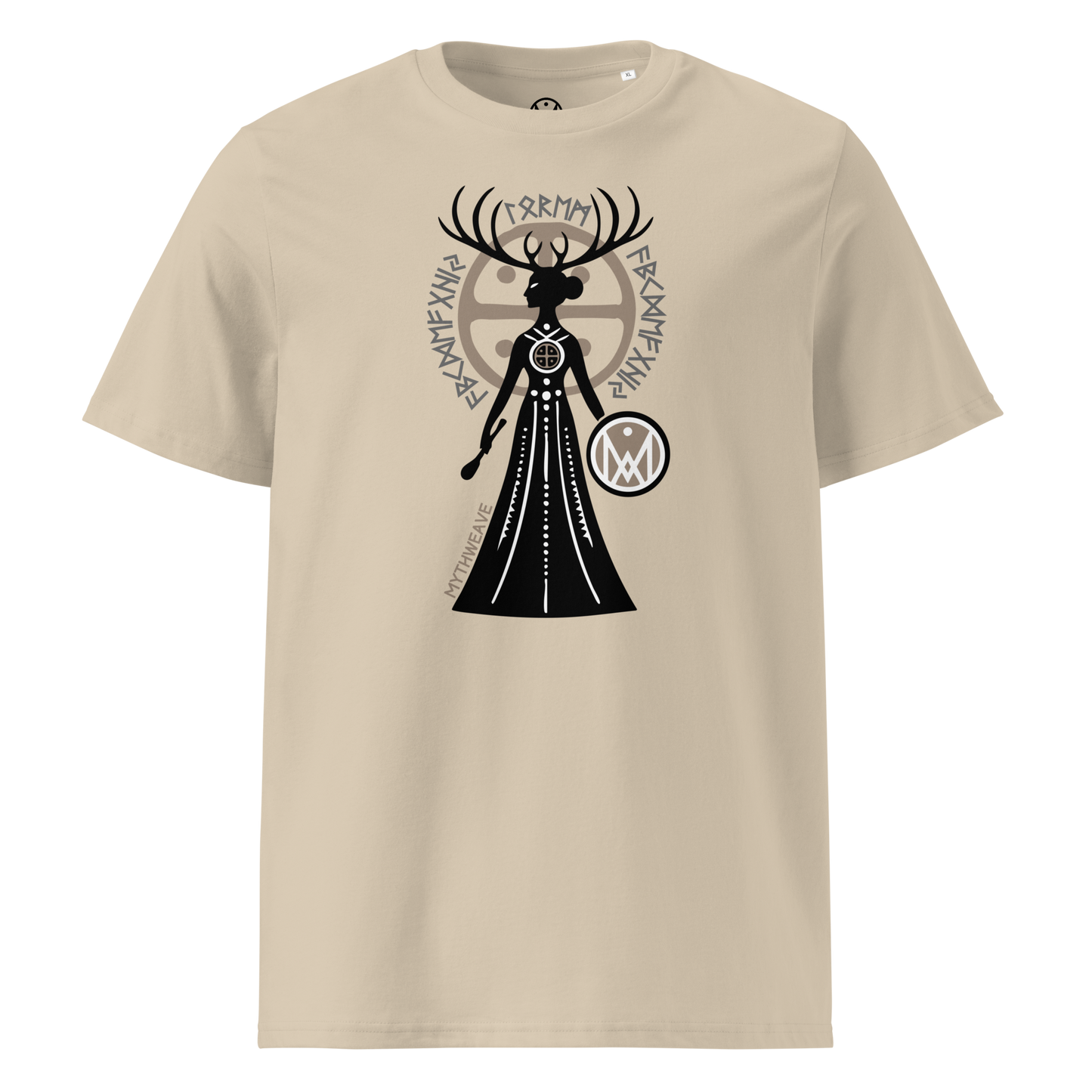
Faced with climate crises and ecological imbalances, we are now searching for new narratives to give meaning to our connection with the Earth. Yet, these narratives have always existed: the founding myths of many civilizations.
From the goddess Gaia in Greek mythology to Pachamama in the Andes, via nature deities among the Celts, Hindus or Nordic peoples, myths remind us of a forgotten truth: the Earth is not a resource to be exploited, but a mother to be honored .
Let's explore how these ancient stories illuminate our modern vision of spiritual ecology and how they can inspire our daily choices, even in sustainable fashion .
Gaia: The Living Earth of Ancient Greece
In Greek mythology, Gaia is the primordial goddess, the Earth Mother. She gives birth to the gods, the mountains, the sea, and embodies the creative power of the world.
For the Greeks, our planet was alive . Any harm done to Gaia was a sacred offense.
Today, the concept of " living Gaia " has even inspired scientists like James Lovelock, who proposed the Gaia theory : the Earth functions as a self-regulating organism. A mythological intuition that has become a scientific and ecological vision.
Pachamama: the Nourishing Mother of the Andes
Among the Andean peoples, Pachamama is Mother Earth, the one who nourishes, protects, and balances. Even today, farmers offer her coca leaves, fruits, or grains to thank nature and restore harmony.
The myth of Pachamama teaches us gratitude : the Earth gives, but she also expects us to take care of her. In an age of overconsumption, this vision reminds us that ecology is both a science and a sacred relationship .
The myths of the North and of the world: a universal appeal
In Norse mythology, the Earth is called Jörð , mother goddess and lover of Odin. Among the Celts, Danu is the womb of all the gods. In Hinduism, the Earth is Bhumi Devi , a revered and protective deity.
Everywhere, the stories converge: the Earth is feminine, creative, nurturing . She is both our origin and our destiny.
These myths reveal a universal link: recognizing that nature is sacred is an intuition common to all cultures.
Myths and modern ecology: a legacy to be reinvented
Today, talking about ecology often means discussing figures, carbon footprints, and statistics. But myths offer us another perspective: that of the sacred and the sensory .
Reintegrating Gaia, Pachamama or Jörð into our collective imagination means restoring a poetic and spiritual dimension to ecology.
It is understanding that responsible consumption is not a sacrifice, but a ritual of respect.
It is also about finding a balance: taking only what we need, as the Andean concept of ayni (reciprocity) reminds us.
Reconnecting with the sacredness of the Earth
Myths and ecology are not two separate worlds. On the contrary, they nourish each other. The stories of Gaia, Pachamama, Danu, Jörð, or Bhumi Devi remind us that the Earth is a living mother .
Integrating these symbols into our modern lives is a step towards more conscious consumption and an ecology imbued with the sacred .
Choosing an ethical garment made of organic cotton or a mythological poster means extending these ancient stories into our daily actions.