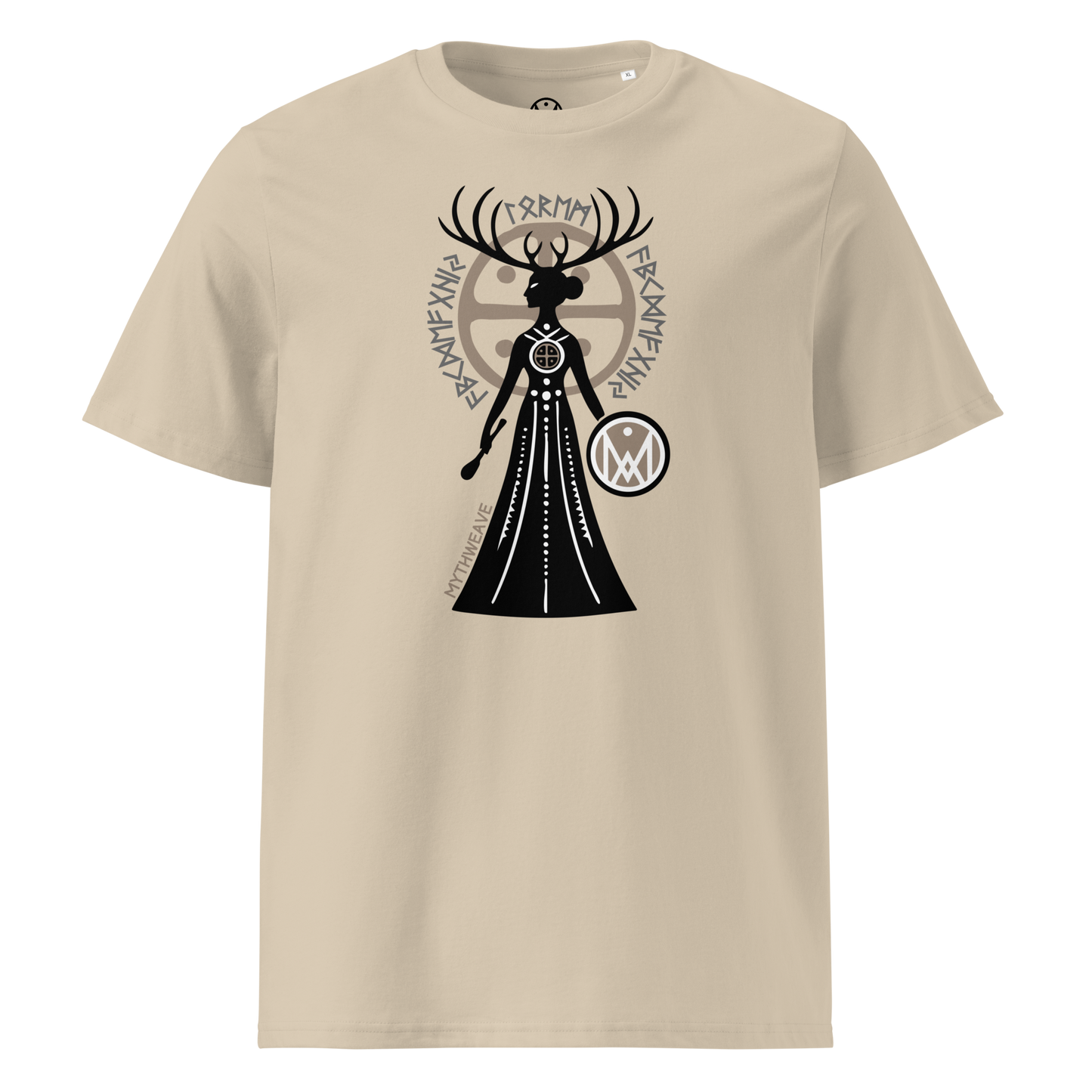
In our modern societies, clothing is often reduced to a single function: covering ourselves, protecting ourselves, displaying a style. But in other cultures—ancient or present— fabric is a sacred talisman , a fragment of power, a living memory. What if every piece of fabric carried within it an intention? A story? A protection?
On this textile journey, let us embark together on a discovery of these civilizations where not only clothes are woven… but also spells, prayers and invisible legacies.
Silk in China: Between Imperial Breath and Vital Energy
Let's begin our journey in ancient China , the cradle of silk , this delicate fiber from the cocoon of the silkworm. Used as early as 2700 BC, silk, in addition to being luxurious, was a symbol of harmony .
According to Taoist thought and the principles of Qi, silk helps maintain the body's energy balance . It protects against the cold without blocking breath, and caresses the skin without irritating it. It is soft like water, fluid like Chi .
Chinese dignitaries wore robes woven with symbols : dragons, clouds, immortal cranes. Each motif had a magical function, an implicit wish: longevity, wisdom, prosperity.
In Chinese tradition, clothing becomes a spiritual second skin , a way to connect with Heaven, Earth, and ancestors. Silk then becomes a textile and a talisman of balance and inner nobility .
Linen in Egypt: light embodied in fabric
Let us leave the misty mountains of China and descend to the golden banks of the Nile , where linen was woven as an offering to the sun.
For the ancient Egyptians, white linen represented purity, light, and eternal life . Worn by priests, pharaohs, and the dead in their sarcophagi, linen was perceived as a living material . It captured light, transmitted the divine heat of Ra, and symbolized the transition to the afterlife.
Even in everyday life, linen clothing was chosen with care: the finer and more transparent it was, the more noble and protective it was considered . Weaving linen was like inviting the light of the celestial world into the earthly world .
Tartan in Scotland: the thread of a clan memory
From the heat of the desert, let's move up to the cold and misty lands of Scotland, where tartan has stood for centuries as a symbol of belonging and resistance .
Each Scottish clan had its own pattern, its own color combination. Wearing tartan was a way of asserting one's name, lineage, land, and honor . And in the darkest hours of history, tartan was banned by the English , deemed too symbolic, too powerful. Even today, tartan remains a woven banner , a collective memory worn on the shoulders, on the kilt, or in the buttonhole.
In some contemporary neo-Druidic rituals, tartan is even used as a magical fabric , linked to the earth, ancestors, and clan spirits. A totem-fabric , in short, whose threads are not only wool… but also blood, myth, and loyalty.
African tribal motifs: the word of the ancestors woven into fabrics
Let's journey down to Africa , a continent of symbols, rhythms, and powerful fabrics. Here, every motif tells a story , every textile is a living word, a visual language . From the Adinkra fabrics of Ghana to the Bogolan of Mali, and the Wax prints carrying coded messages, African clothing is used to bless, protect, challenge, or seduce .
The fabrics are worn during rites of passage, initiations, weddings or mourning. They transmit tribal identity, ancestral wisdom, and even political messages .
Some motifs are considered sacred glyphs , not to be worn without initiation. Other fabrics are dyed using ritual processes involving plants, chants, and sometimes dances. In contemporary African and Afro-descendant art, these textiles are reinvented as modern talismans , reconnecting the body to its history and the soul to its roots.
The sacred belts of India: the link between the body and the universe
In India, many traditional garments carry subtle powers, but braided fabric belts, called "kamarband" or "mouli," have a profoundly magical significance . These cords, in addition to being decorative, serve to seal prana (life energy) in the lower abdomen, to protect energy centers , and sometimes to symbolize commitment to a spiritual path.
In Hindu rituals, red threads are tied around the wrist or waist to bless, protect, and signify divine affiliation . These fabrics are sometimes soaked in mantras, sacred ashes, or ritual oils.
The fabric then becomes a channel of intention , a vector of energy, an invisible pact between the individual and the cosmos.
Shamanic textiles of South America: visions worn on the self
Let us conclude this journey in the Andes or the Amazon rainforest , where shamans weave their visions into colorful fabrics. The Shipibo-Konibo, an indigenous people of Peru, are famous for their hallucinatory geometric patterns , which reproduce the icaros chants received in trance .
These patterns vibrate , they sing, they heal. Wearing Shipibo fabric is like wrapping yourself in a sacred melody , in a protective frequency.
In shamanic rituals, clothing becomes spiritual armor , each stitch of embroidery acting like a sewn mantra, an intention anchored in matter.
A common thread runs through all these cultures.
Across all these cultures, a common thread clearly emerges: clothing is an extension of the soul . It protects, it expresses, it connects. It is simultaneously memory, armor, offering, and spiritual channel . And what if today, amidst the turmoil of fast fashion, we restored clothing to its sacred meaning? What if each garment we wear became an invocation, a commitment, a story to honor ?
MythWeave is part of this approach: to weave a bridge between worlds , between ancient myths and today's values, between ethics, soul and elegance.
If this exploration resonated with you, share it in turn… and discover how every garment can become a modern talisman , by exploring the MYTHWEAVE collection 🌿